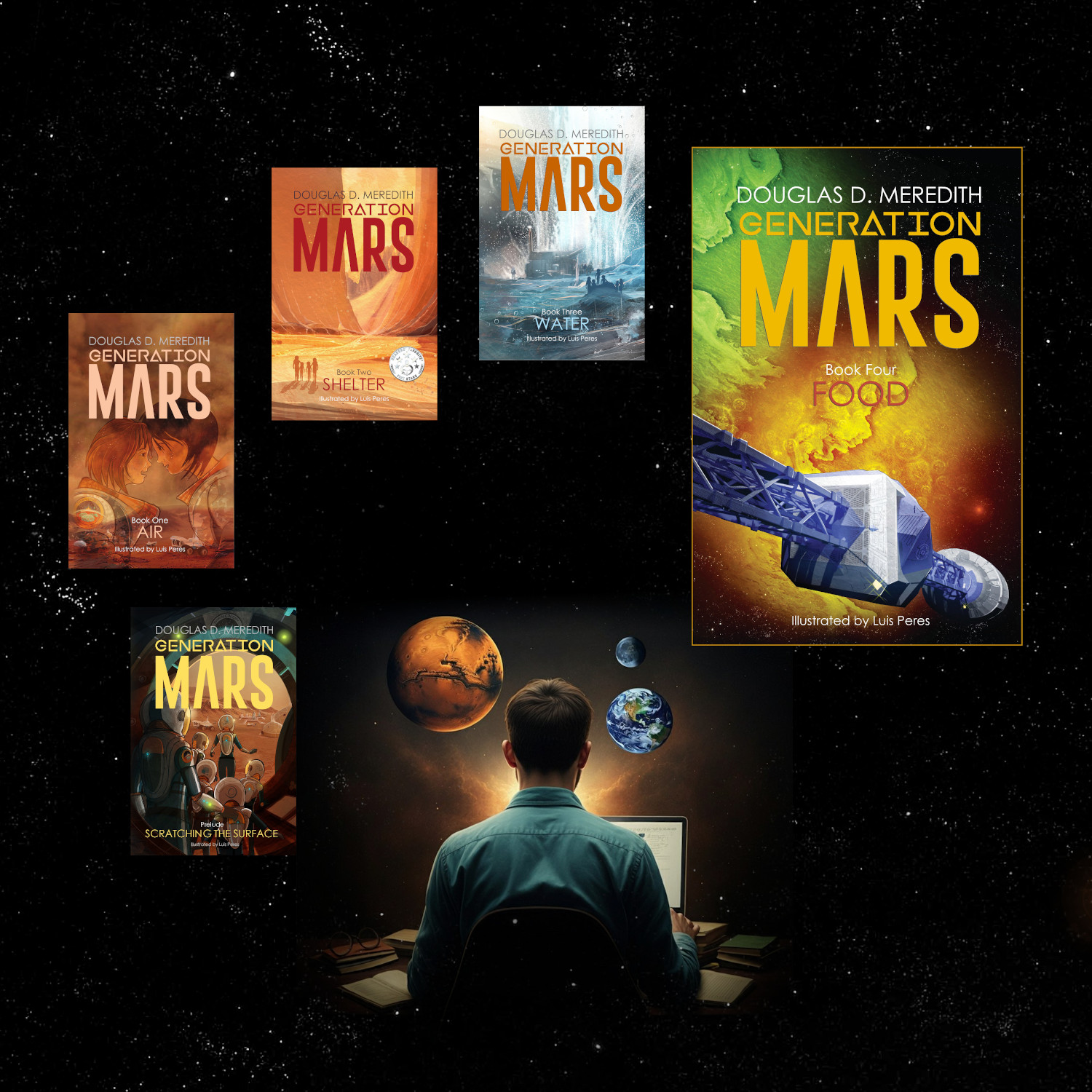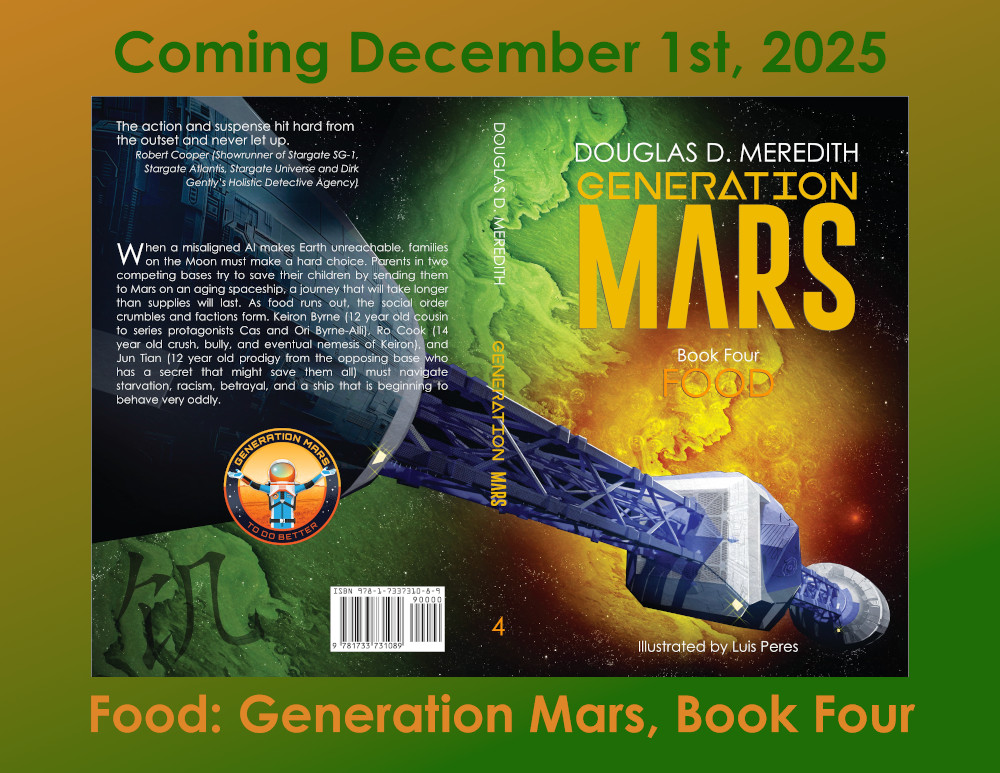

Food: Generation Mars, Book Four now available

Food: Generation Mars, Book Four has landed!

https://www.amazon.com/Food-Generation-Mars-Book-Four/dp/1733731083

Air, shelter, water, food: that was the plan. Following the success of the first book, Scratching the Surface, I would write four more. Each book would be a chapter book for advanced early readers and would address one of these fundamental elements of survival with a little vignette in which my protagonists deal with a crisis and, through their actions, teach the reader a little about science.

Things did not go to plan. I had too much to say for such constraints to hold. You might say my primary alignment failed and I broke containment.

Now, here we are at Food, the last planned book, and it’s a whopper. Believe me when I tell you: there is a lot in this book. I’m not even sure it’s a kids book. Categorizing it has been a challenge. Let’s say it’s upper middle grade/early young adult. Actually, no, let’s abandon such synthetic labeling and say it’s for anyone 11 to 100 who enjoys a rousing adventure with pathos and science and suspense and humor and failure and triumph. (For kids younger than that, parents may want to pre-read.)

What’s it like to release the last book in a series? I feel… wistful. A little. My own kids are growing up, just like my characters, and it’s hard to let eras go. But that’s what parents and authors must do. So–*sniffle*, *deep breath*–here it is, the last book of the Generation Mars series.

Well, sort of. The thing about eras is that there is always another. Food completes the planned survival element framework and ends in a satisfying place for the characters. But it also leaves the situation on Mars and Earth in a mess. That was on purpose. You should always leave a mess for the next series to clean up…

Food update

Status update for Food, Generation Mars, Book Four

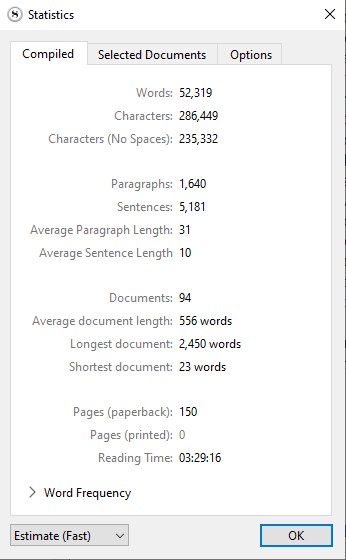
At some point during the past week, the manuscript passed 50K words.

Manuscript is a loose term that covers everything from get-it-down-and-fix-it-later sketch to fully edited and ready for formatting.

At this point, Food is closer to the sketch. A 50K sketch. I won’t say much more, but I will say this: It keeps surprising me, and I think it will surprise you too.

Food update

A milestone update on Food: Generation Mars, Book Four

1) The entire book is plotted (or, at least, as plotted as I am willing to go while also leaving room for surprise). All I’ll say is that this one is monumental in scope and will take your breath in the first chapter and keep it until the last.

2) As of today, I passed 5000 words in the initial manuscript. A pittance in the face of this monster, but a milestone to be celebrated nonetheless.

image: generated by ImageFX

Envelopes

Is cannibalism appropriate for middle grade? Asking for a friend…

But seriously, this next book is shaping up to push the envelope. Several envelopes. All the envelopes, maybe.

image: Twemoji (https://commons.wikimedia.org/wiki/File:Twemoji12_1f914.svg), https://creativecommons.org/licenses/by/4.0/deed.en, unaltered

Dawn Colony

“What brought you to Mars?” said Ori. The adults in the colony had grown up on one planet then decided to move to another. Why they did this was a topic that interested all the kids.

“It was the culture,” said Katy. “I realized Dawn was the greatest experiment in human culture ever conducted, so I came to see it myself. I only planned to be here one year, but then the Schism occurred.” Ori knew that term meant the time when the Martian colonists refused to return to Earth. “I knew the changes that would cause would be profound,” said Katy, “and I had to be here to record them.” She paused, remembering. “That’s partly true, at least. But, also, I loved what I saw happening on Mars and wanted to be part of it. So, when the last transport left for Earth, I stayed.”

From Water: Generation Mars, Book Three. Available now at https://www.amazon.com/Water-Generation-Mars-Book-Three/dp/1733731067


Image: Dawn Colony mission patch


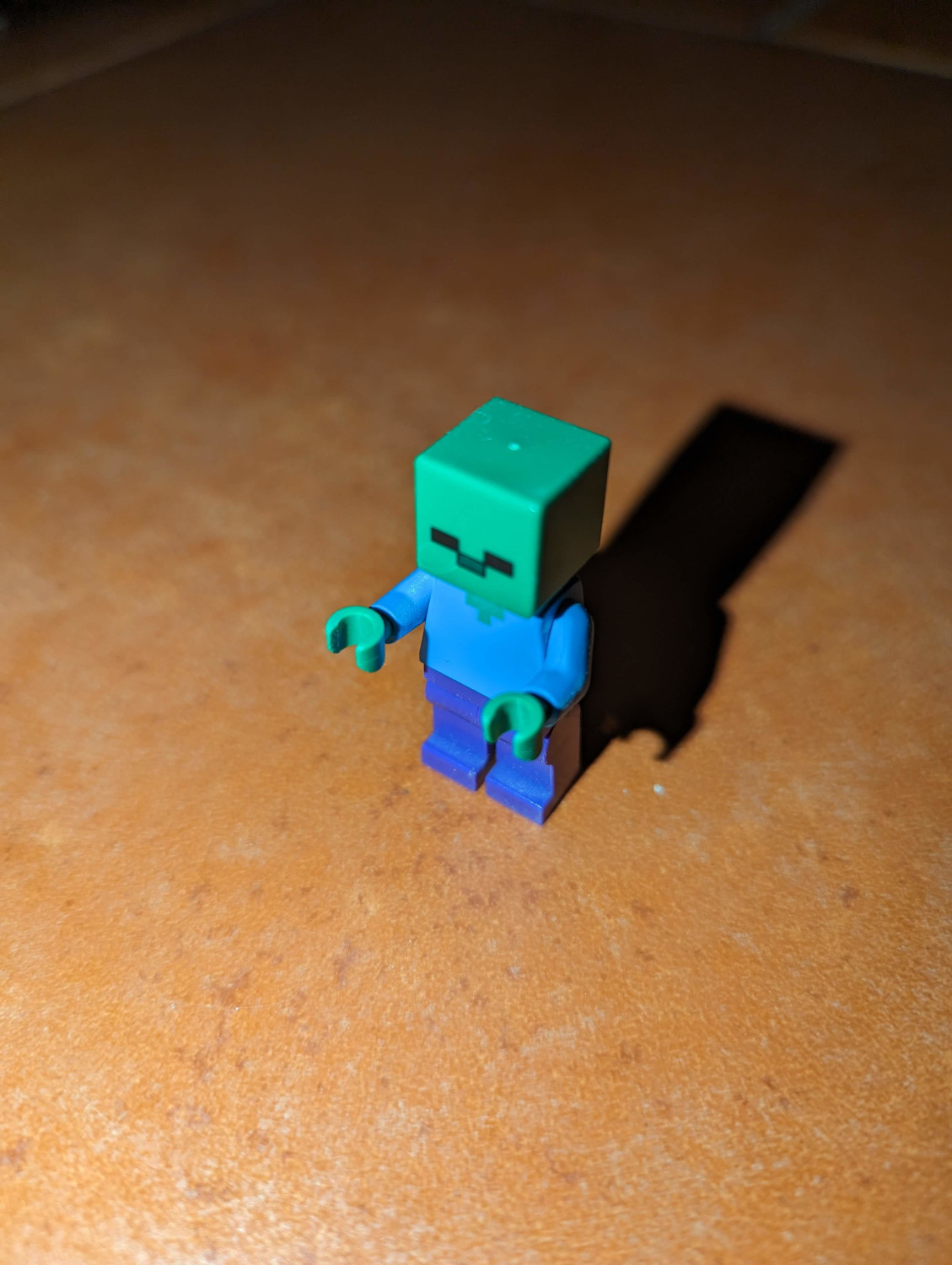
Zombies?

The opening was a ramp leading down into darkness. Tomás went into a small booth next to the hole and flipped some switches. The darkness below suddenly blinded them with brightness as the lights came on and reflected up at them from the blue-whiteness of the ice. Their visors quickly attenuated the difference in lighting, and they were able to see again.

“That should keep zombies away, no?” said Tomás.

The kids looked at him questioningly. Katy cleared her throat. “Tomás is referring to an old computer game from Earth. We don’t need to worry about zombies.”

“Si, not now,” he said.

She slugged him in the arm. The kids smiled.

From Water: Generation Mars, Book Three. Available now at https://www.amazon.com/Water-Generation-Mars-Book-Three/dp/1733731067

Image: my own

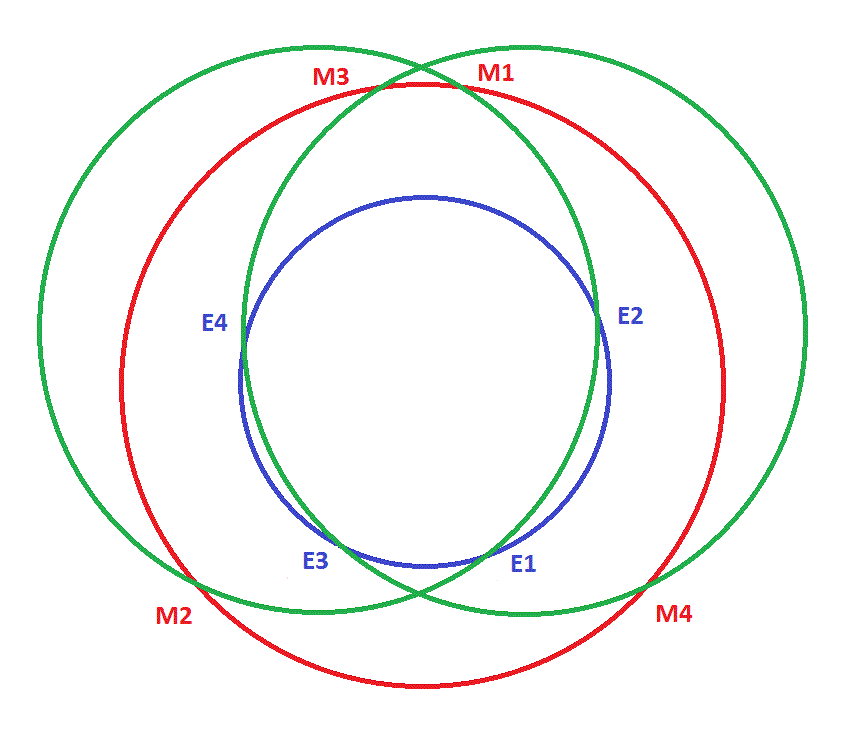
Cycler

“What happened to all that hydrogen?” someone asked.
“Until trade stopped, most of it went to Earth via the cycler,” said Katy.
A hand went up. “What’s the cycler?”
Tomás looked at Katy to see if he could answer. Katy nodded. “Is spaceship,” he said, “in a special orbit around the Sun that brings it near Mars every sixteen months. We load it with hydrogen and, 146 days later, it pass near Earth. They unload. Then off it goes for sixteen months until it comes back by. There are actually two of these in different orbits. Other is used to send supplies and people from Earth to Mars.”
A hand went up. “Are they still there?”
“Oh yeah,” said Tomás. “Some of you might remember the last time we have delivery from Earth several years back. Now they just circling around, waiting.”
A hand went up. “Waiting for what?”
“Until Earth need our hydrogen again.”

From Water: Generation Mars, Book Three. Available now at https://www.amazon.com/Water-Generation-Mars-Book-Three/dp/1733731067

Image: Aldrin cycler orbital diagram from Hawkeye7, https://creativecommons.org/licenses/by-sa/4.0/deed.en


CCF

After a few minutes of questions and answers, Nour started the rover and resumed the descent. Several minutes later the big rover drove out onto the ice sheet. Here, perhaps owing to the protection of the crater rim, the road was more distinct. The ice, which did not look like ice, was not flat. There were ridges and contours that mimicked the shape of the crater. These were called concentric crater fill and were caused by the slow movement of the ice as it had receded and grown, receded and grown through the millions of years it had existed in this crater. The road wound its way through these ridges until it reached the cluster of buildings and tanks and that gaping hole.

From Water: Generation Mars, Book Three. Available now at https://www.amazon.com/Water-Generation-Mars-Book-Three/dp/1733731067

Image: NASA


On the rim

Nour guided the rover to the south side of the crater. A natural gap in the rim here provided access to the inner crater, and a road had been cut that ascended to this gap then descended the rim in several broad switch-backs. The kids oohed and cooed as the rover tipped and swung its way up the road. A couple of them looked a little ill from motion sickness.

From Water: Generation Mars, Book Three. Available now at https://www.amazon.com/Water-Generation-Mars-Book-Three/dp/1733731067

Image: illustration (color version) by Luis Perez for Water, Generation Mars, Book Three (please note: book interior illustrations are grayscale)