Music notes for Food

Kyle Tran Myhre deserves a special place in my series of posts on #GenMarsFoodMusic.

I use the final verse of his piece called “Matches” as an epigraph for Food because it captures the essence of hopepunk.

It reminds me of the Carl Sagan quote: “In our obscurity, in all this vastness, there is no hint that help will come from elsewhere to save us from ourselves.” The obvious point being that we’d best get on with doing it ourselves.

It captures the hope-despite-hardship of my characters as they struggle with starvation and social collapse. It captures the hope-despite-hardship of all of us in our own struggles IRL.

It’s about self-reliance, except the self is collective. We succeed when we all take care of each other.

Kyle’s are the first and third verses here:
https://music.youtube.com/watch?v=6rphS6Ux-wY

To learn more about Kyle and his many activities, visit:
https://guante.info/

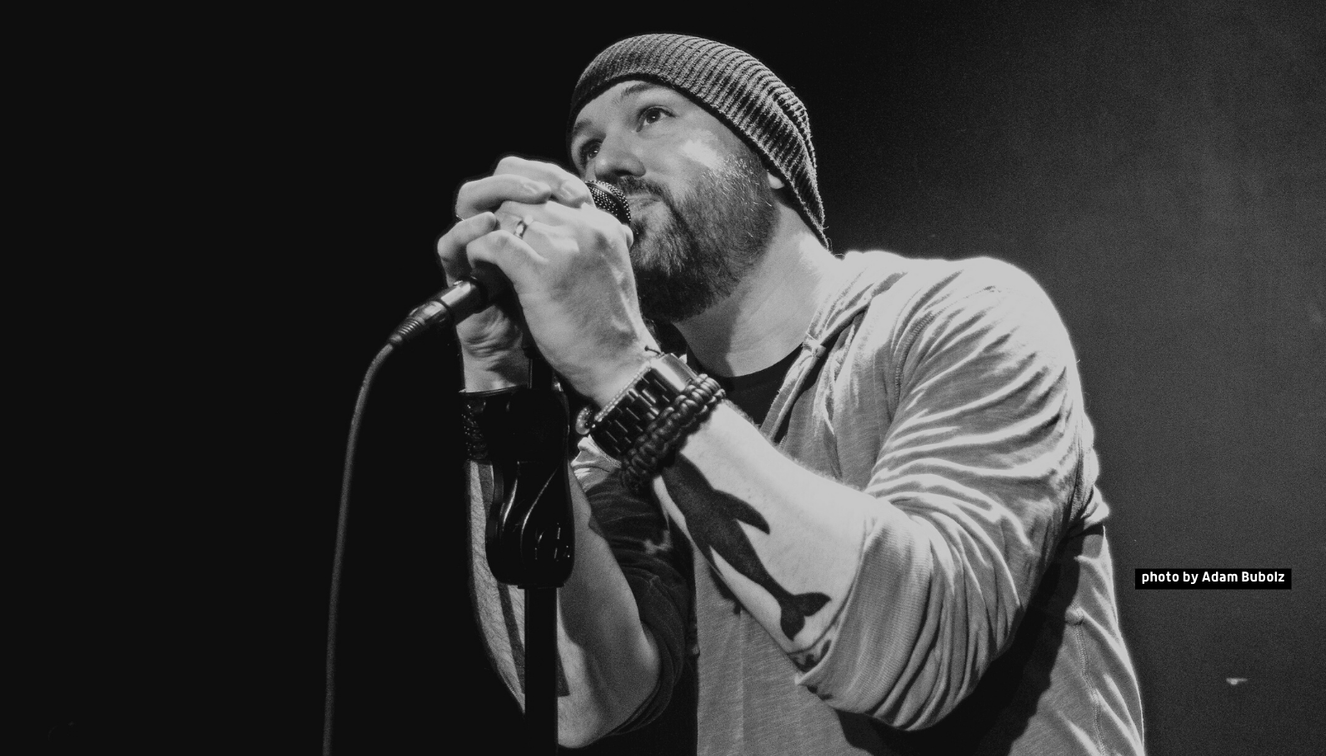
image: Kyle Tran Myhre performing. Taken by Adam Bubolz.

Music notes for Food

Many years ago, I went to Bolivia to help a friend with some field research. We stayed on a remote ranch in the Gran Chaco, an arid grassland in the southern part of the country. One night, as we were sitting and drinking beers with the rancher, he shared that he liked Mexican music. Being a young white American from the exact center of the country and only beginning to shed the cultural myopia which that entails, I found this eye-opening. It’s not like I didn’t know Latin America contained many countries, but I’d never really thought of them as being different from each other, you know? The idea that this rancher in southern Bolivia was a fan of Mexican music kind of slapped me and opened up my worldview in a most charming way.

I was thinking of this when I wrote a scene in which my Chinese protagonist shares Isan music from northern Thailand with his American friend.

Excerpt:
“Jun pulled out his tablet and touched it several times to cast music to the room’s sound system. Something like a guitar began noodling out an arrhythmic introductory riff that eventually settled into a repetitive pattern. This became more complex with each measure, building intensity until finally, drum and bass joined. Jun saw Keiron’s head begin to bop subtly up and down when the beat dropped.”
— from Food: Generation Mars, Book Four

Pretty sure this was the track I described.

https://www.youtube.com/watch?v=F2VXJ-Gyle4

https://open.spotify.com/track/4KKOeMWgKcHEle0chfj8hd?si=46c975d01b5548c6

Music notes for Food

I listen to a lot of music when I’m writing. At these times, I prefer instrumental things that don’t tug at my Wernicke’s. Phish is a good fit for this. On the journey to Mars, one of my characters listens to Phish much of the time. So did I as I wrote.
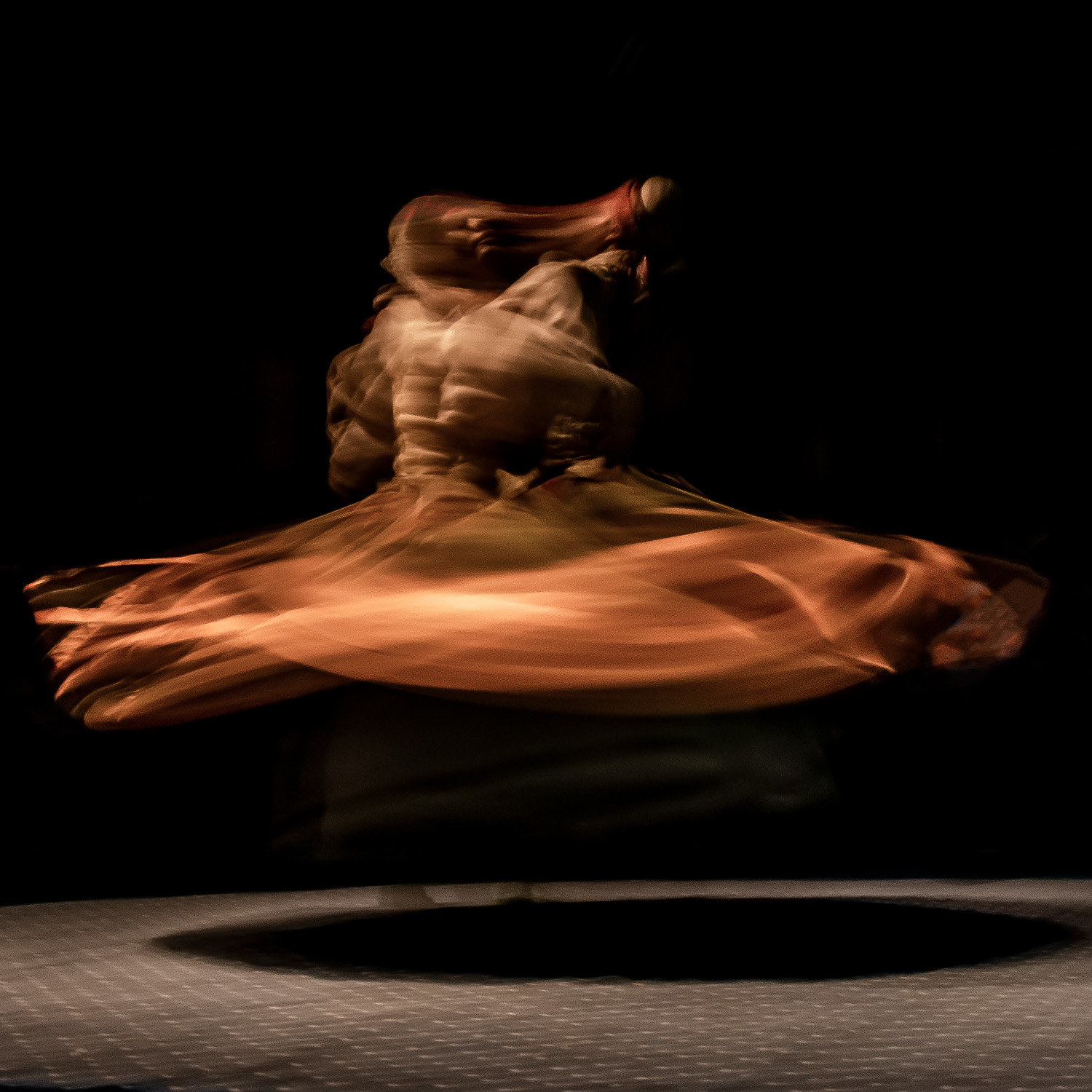
The image of a kid reclined and looking out at the stars as they move around him grabbed me early on. Pairing it with a long Phish jam seemed natural. The idea that this activity soothed his loneliness and hunger still causes me to tear up if I dwell on it for long. Music will do that.

An excerpt:
“Music played loudly from speakers hidden throughout the room. Guitar and keyboard and bass and drums were riffing and circling each other in a long and exuberant jam. As he watched the stars slide past behind the other pod, Keiron imagined he could feel the movement of the ship as it spun around its hub while following its orbit around a star that was circling the center of a galaxy, circles within circles within circles. In his mind, he got up from his chair and started spinning and dancing to the music, circles within circles within circles within circles. He had no energy for such activity, of course, but was content just to lie there and imagine it.”
–from Food: Generation Mars, Book Four

Here’s a track called Twist, from the live album Baker’s Dozen. After the abstract intro, it’s a classic example of a Phish jam piece.

https://www.youtube.com/watch?v=ldC6WHIz99Q

https://open.spotify.com/track/7bSpTQPBOQU2xiVl4LVS9K?si=a9e818bfc9624099

Key points of a Phish jam: There is usually an opening, with verses and chorus and bridge. The lyrics might be clever or meaningless. They’re just part of the vibe, so don’t look for deep universal insight. That’s found later and does not involve words. This section would be called the “head” in jazz parlance. Then there is often an extended period of quiet vamping, as the band members circle each other, waiting to see what will happen. They are looking for ground to launch from. Casually. Anticipation is the thing, and there is no hurry. In fact, you may not even realize it’s happened. At some point, you will notice you’ve lost track of details. The song has spun into something exquisite, possibly unexpected, and often nothing like the head. You might be spinning around the room. Maybe your head simply bobs as you type. Either way, you are smiling uncontrollably.

Hopefully, nobody walks in and poops on your vibe.

Image: Blurred image of a Tanoura dancer. Tanoura is a traditional folk dance in Egypt, where dancers spins to the tunes of Arabic songs. From Wikimedia Commons, by Dalia farid. License: Creative Commons Attribution-Share Alike 4.0 International (https://creativecommons.org/licenses/by-sa/4.0/deed.en). Image has been cropped.

Music notes for Food

There are many musical references in my latest book. Such references are a challenge for an indie author. I have to be careful to not cross any fair use boundaries: artists and titles and bare hints of lyrics only. So I thought it might be fun to elaborate on some of them here.

Food: Generation Mars, Book Four now available

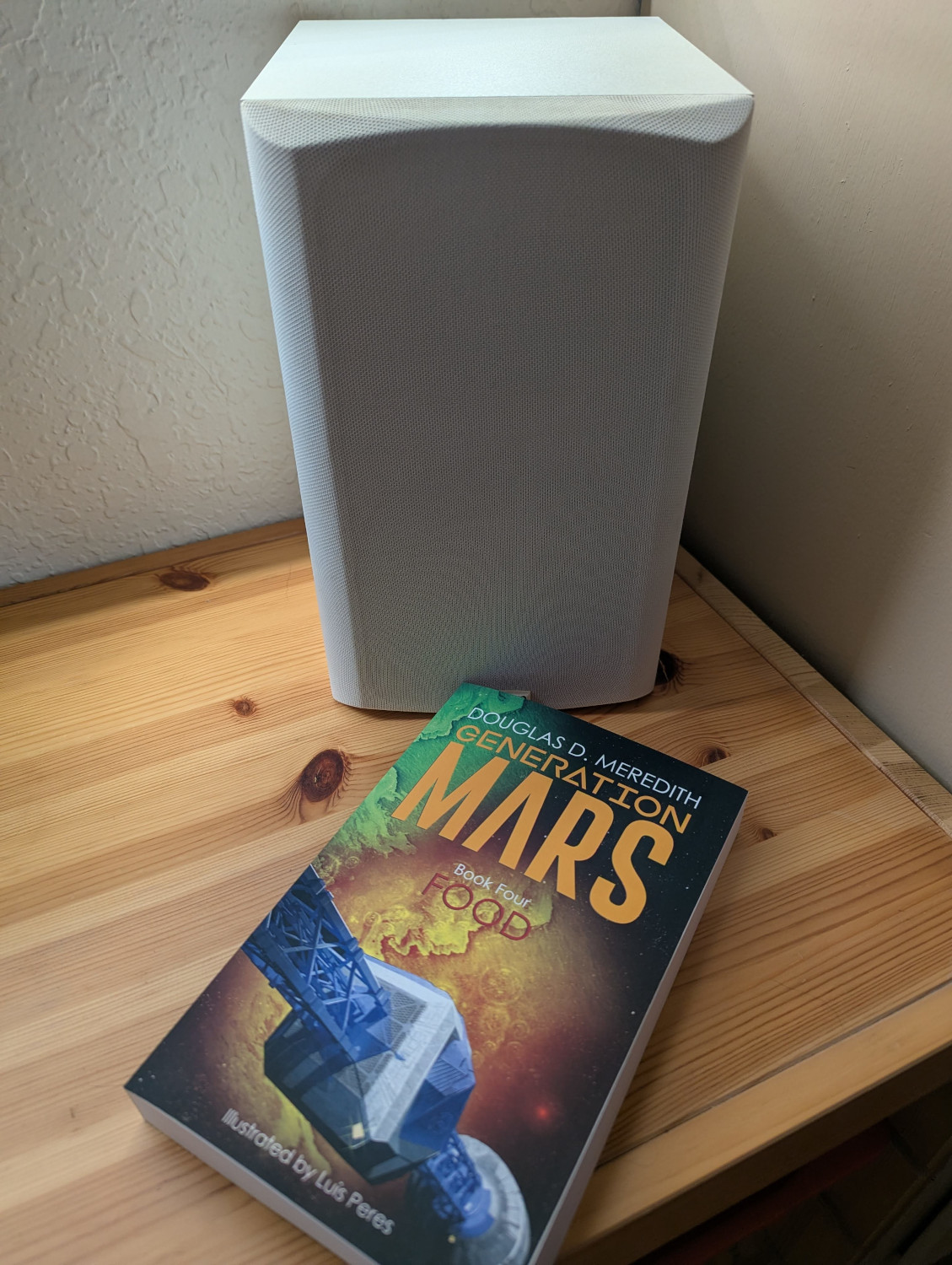
Food: Generation Mars, Book Four has landed!

https://www.amazon.com/Food-Generation-Mars-Book-Four/dp/1733731083

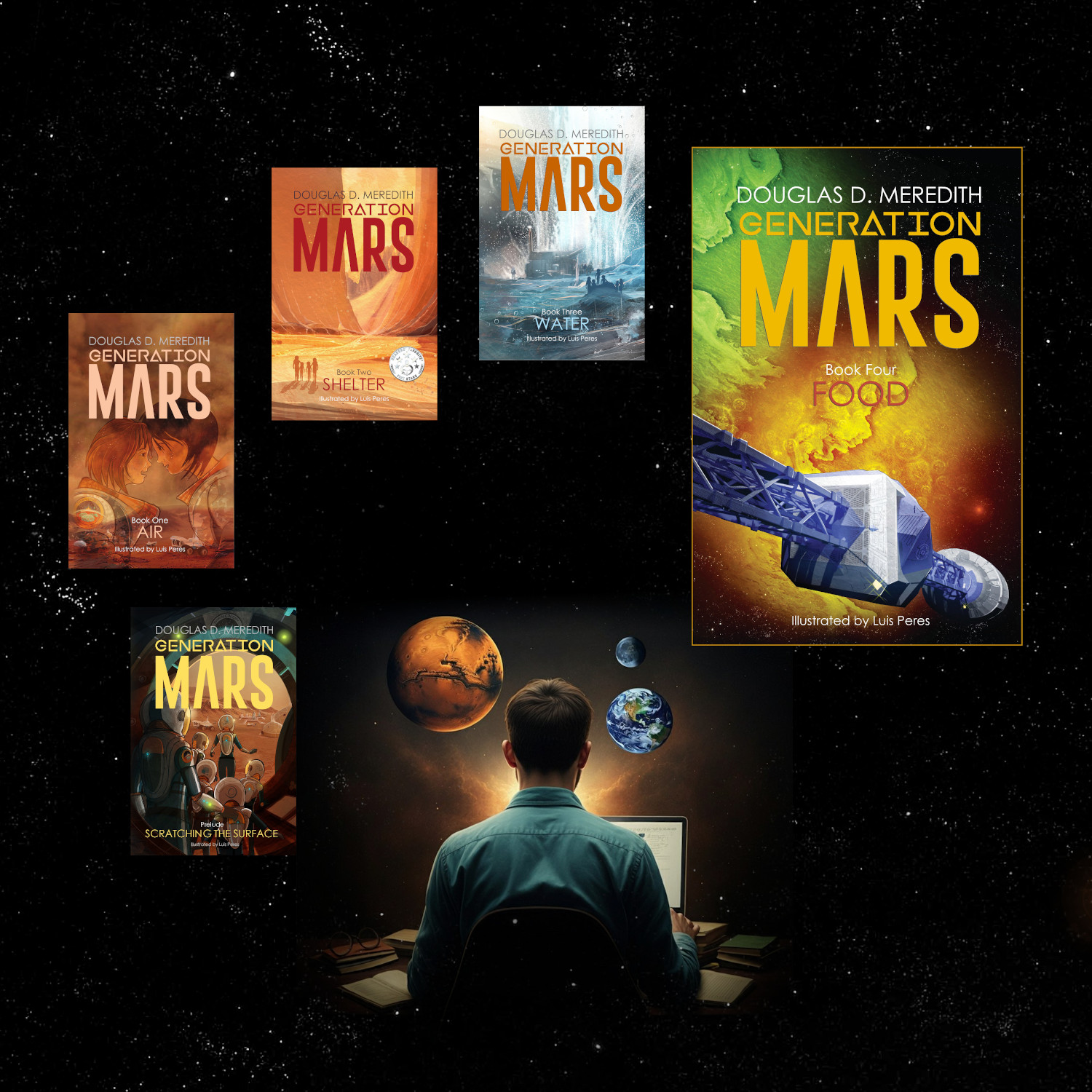
Air, shelter, water, food: that was the plan. Following the success of the first book, Scratching the Surface, I would write four more. Each book would be a chapter book for advanced early readers and would address one of these fundamental elements of survival with a little vignette in which my protagonists deal with a crisis and, through their actions, teach the reader a little about science.

Things did not go to plan. I had too much to say for such constraints to hold. You might say my primary alignment failed and I broke containment.

Now, here we are at Food, the last planned book, and it’s a whopper. Believe me when I tell you: there is a lot in this book. I’m not even sure it’s a kids book. Categorizing it has been a challenge. Let’s say it’s upper middle grade/early young adult. Actually, no, let’s abandon such synthetic labeling and say it’s for anyone 11 to 100 who enjoys a rousing adventure with pathos and science and suspense and humor and failure and triumph. (For kids younger than that, parents may want to pre-read.)

What’s it like to release the last book in a series? I feel… wistful. A little. My own kids are growing up, just like my characters, and it’s hard to let eras go. But that’s what parents and authors must do. So–*sniffle*, *deep breath*–here it is, the last book of the Generation Mars series.

Well, sort of. The thing about eras is that there is always another. Food completes the planned survival element framework and ends in a satisfying place for the characters. But it also leaves the situation on Mars and Earth in a mess. That was on purpose. You should always leave a mess for the next series to clean up…