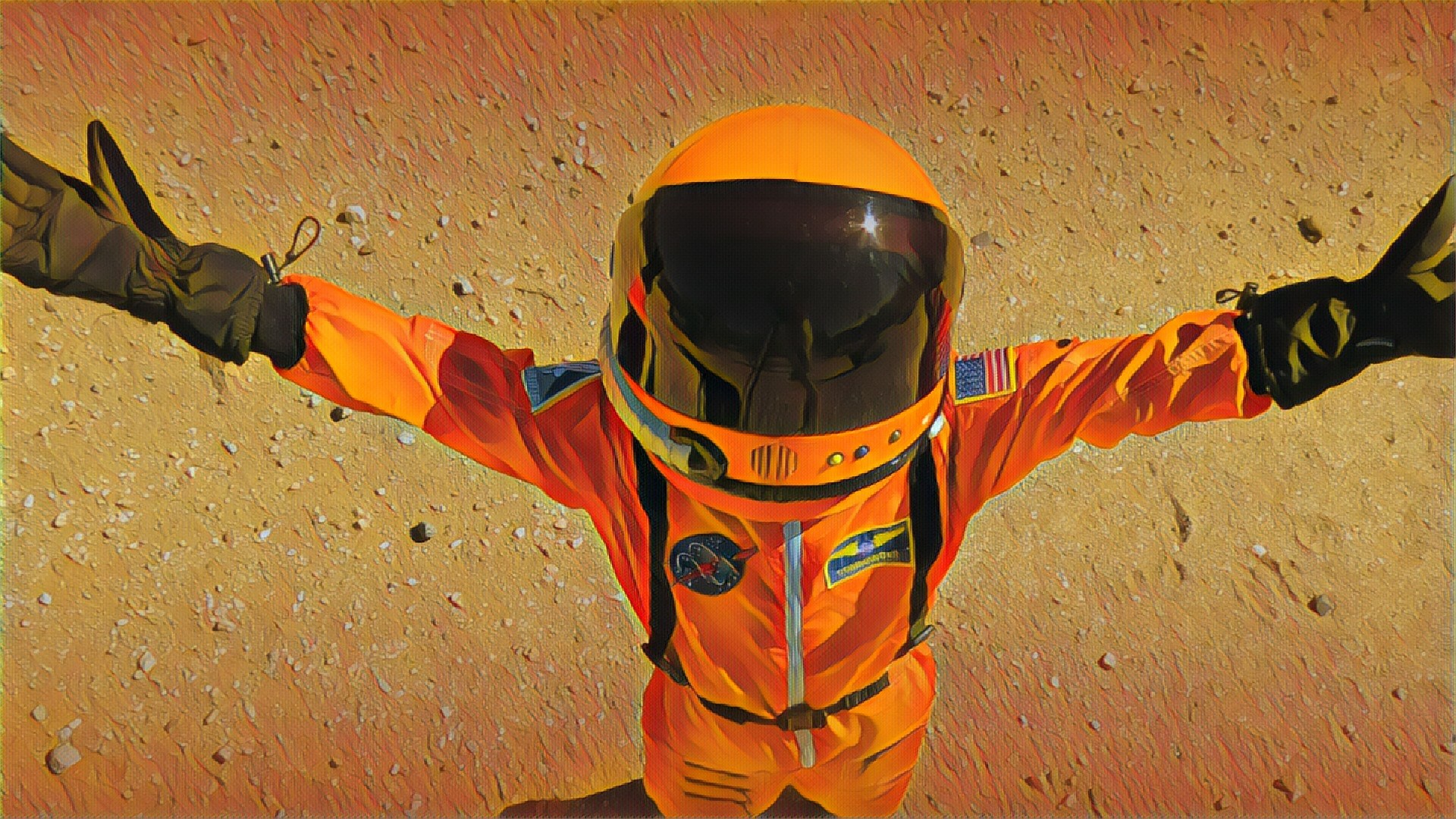

I’ll close this series of posts on the music references in Food with a reference that is not to music: Carl Sagan’s Pale Blue Dot soliloquy.
I mentioned Sagan in my post on Kyle Tran Myhre, and I want to return to the quote I included there, because it is key to what I’ve tried to communicate in this series.
“In our obscurity, in all this vastness, there is no hint that help will come from elsewhere to save us from ourselves.”
One cannot write without being influenced by the times in which one lives. And we are living through some shit. My primary goal with this series has been to provide young readers a vision of hopepunk optimism for our future: that they can build the society they want to live in. But, as I’ve written these books about humankind’s first generation off Earth, I have occasionally struggled to maintain that positive attitude. At these times, that sentence from Sagan’s speech has returned to mind and centered me. It’s a rallying call.
Excerpt:
“We don’t need someone to save us. What does that even mean?” She paused “Look,” she said, “we’re complicated. Kind of a mess, actually. We rarely live up to our ideals. But we try.” She paused again. “We save ourselves,” she said.
— from Food: Generation Mars, Book Four
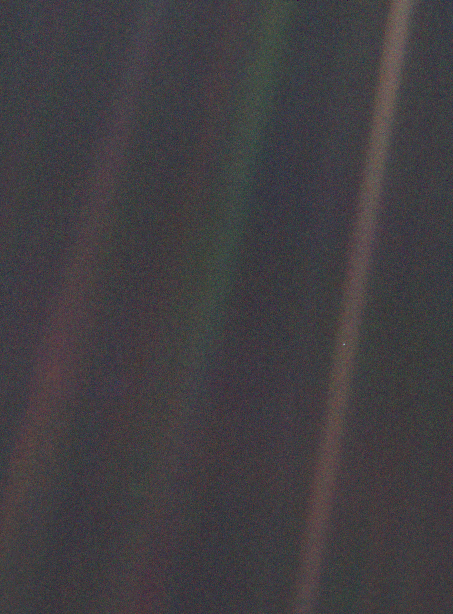
Image: Original caption: This narrow-angle color image of the Earth, dubbed ‘Pale Blue Dot’, is a part of the first ever ‘portrait’ of the solar system taken by Voyager 1. The spacecraft acquired a total of 60 frames for a mosaic of the solar system from a distance of more than 4 billion miles from Earth and about 32 degrees above the ecliptic. From Voyager’s great distance Earth is a mere point of light, less than the size of a picture element even in the narrow-angle camera. Earth was a crescent only 0.12 pixel in size. Coincidentally, Earth lies right in the center of one of the scattered light rays resulting from taking the image so close to the sun. This blown-up image of the Earth was taken through three color filters – violet, blue and green – and recombined to produce the color image. The background features in the image are artifacts resulting from the magnification.
NASA
Public domain