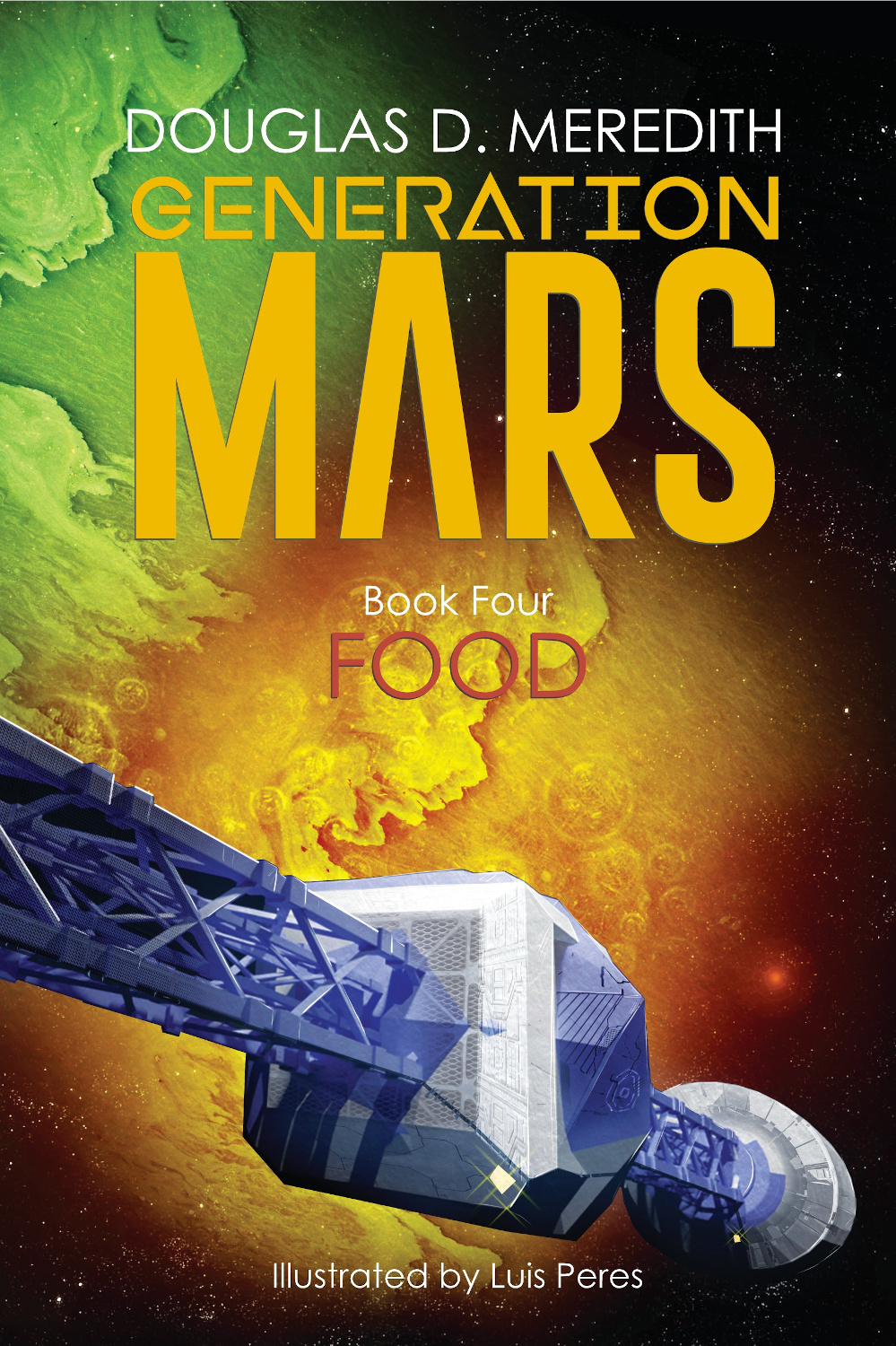
When a misaligned AI makes Earth unreachable, families on the Moon must make a hard choice. Parents in two competing bases try to save their children by sending them to Mars on an aging spaceship, a journey that will take longer than supplies will last. As food runs out, the social order crumbles and factions form. Keiron Byrne (12 year old cousin to series protagonists Cas and Ori Byrne-Alli), Ro Cook (14 year old crush, bully, and eventual nemesis of Keiron), and Jun Tian (12 year old prodigy from the opposing base who has a secret that might save them all) must navigate starvation, racism, betrayal, and a ship that is beginning to behave very oddly.
Reviews:
Douglas Meredith delivers another fantastic installment in the Generation Mars series both kids and adults won’t be able to put down. The action and suspense hit hard from the outset and never let up, but this book also tackles so much more. Doug’s incredible at making hard science fun and essential while weaving profound human truths into a narrative that never underestimates his audience. What I appreciate most about the series is his portrayal of families and children mature beyond their years who, while flawed, deeply love and respect each other as they strive to be better even while facing life threatening jeopardy, difficult decisions and painful loss. He refuses to simplify complex moral terrain as he tackles profound themes with remarkable nuance, never shying away from unfortunate realities while maintaining hope and agency for his protagonists. The result is science fiction that respects both the intelligence of younger readers and the genuine complexity of the challenges humanity faces as it reaches toward the stars. Put more simply, it’s a great ride that resonates on so many levels!
—Robert Cooper, Showrunner of Stargate SG-1, Stargate Atlantis, Stargate Universe, and Dirk Gently’s Holistic Detective Agency
From the author:
Air, shelter, water, food: that was the plan. Following the success of the first book, Scratching the Surface, I would write four more. Each book would be a chapter book for advanced early readers and would address one of these fundamental elements of survival with a little vignette in which my protagonists deal with a crisis and, through their actions, teach the reader a little about science.
Things did not go to plan. I had too much to say for such constraints to hold. You might say my primary alignment failed and I broke containment.
Now, here we are at Food, the last planned book, and it’s a whopper. Believe me when I tell you: there is a lot in this book. I’m not even sure it’s a kids book. Categorizing it has been a challenge. Let’s say it’s upper middle grade/early young adult. Actually, no, let’s abandon such synthetic labeling and say it’s for anyone 11 to 100 who enjoys a rousing adventure with pathos and science and suspense and humor and failure and triumph. (For kids younger than that, parents may want to pre-read.)
What’s it like to release the last book in a series? I feel… wistful. A little. My own kids are growing up, just like my characters, and it’s hard to let eras go. But that’s what parents and authors must do. So–*sniffle*, *deep breath*–here it is, the last book of the Generation Mars series.
Well, sort of. The thing about eras is that there is always another. Food completes the planned survival element framework and ends in a satisfying place for the characters. But it also leaves the situation on Mars and Earth in a mess. That was on purpose. You should always leave a mess for the next series to clean up…